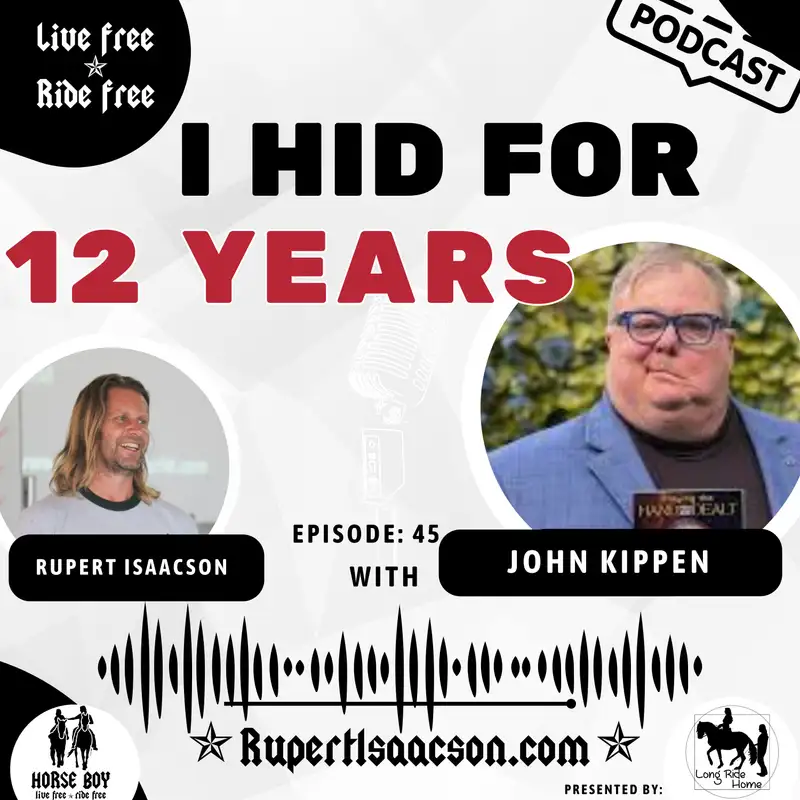
Coming Out of Hiding | Illness, Identity, Magic & the Courage to Be Seen with John Kippen | Ep 45
Rupert Isaacson: Thanks for joining us.
Welcome to Live Free, Ride Free.
I'm your host, Rupert Isaacson, New
York Times bestselling author of
The Horseboy and The Long Ride Home.
Before I jump in with today's guest, I
want to say a huge thank you to you, our
audience, for helping to make this happen.
I have a request.
If you like what we do here,
please give it a thumbs up,
like, subscribe, tell a friend.
It really, really helps
us to make the pro.
To find out about our certification
courses, online video libraries,
books, and other courses,
please go to rupertisaacson.com.
So now let's jump in.
Welcome back to the show.
Today I've got John Kippen.
Here's a question for you.
For listeners and viewers.
Have you ever been
forced to go into hiding?
Have you ever felt that you've
been forced to go into hiding?
Well, what would you do if that happened
to you and how would you come out of it?
Would you come out of it?
If you came out of it?
What would you do with
the rest of your life?
It's worth considering.
John Kippen, who is here, has had that
experience and I'm, without giving
too much away, I think his story.
Puts a lot of our own stories into
perspective and now of course he's a
resilience coach but it was not always.
So John, thank you for coming on the show.
Can you tell us who you are, what you did?
What's your story?
How did you get here?
John Kippen: Thank you for having me here.
My name is John Gibbon.
I live in Los Angeles.
Born and raised here.
Born to two great parents, both attorneys
and I got interested in theater at a
young age and that really taught me
how to be present, think creatively.
My uncle pulled a quarter out of
my ear at the age of five and I
got introduced to Magic and 'cause
I was a creative problem solver.
Looked at it as a challenge, looked at it
as something that I could be good at, and
magic kind of appears throughout my life.
In and out.
I went to a woodsy high school.
Parents had some money.
Was classmates with a lot of celebrities.
Kids didn't phase me, you know,
it was just my up upbringing and
an upper middle class family.
Went to college, studied theater
again got interested in computers,
started a computer consulting company
and everything was going really well.
Was in a relationship and I was, I
was happy, you know, I didn't want
for anything, you know, it was I was
always the guy that was impossible to
buy a gift for because when I would
see something, I would just buy it.
So, but back in 2002, the summer
of 2002, I started having dizziness
symptoms, searing issues, and
they started to get very severe.
So I went and took me about a couple
weeks to get an appointment and so
forth, but I get an MRI and the doctor
saw a four and a half centimeter
acoustic neuroma brain tumor.
Good news is, it's benign.
Bad news is it was killing me
by displacing my brainstem.
And I remember going to the specialist
downtown LA sat on the, the examining
table and I was squirming so I could
hear the tissue paper under my bum,
as you would say, kind of tearing
and revving as he looked at the MRI.
And then he called in a neurosurgeon who
came in and they looked at it together
for a moment and the neurosurgeon left
and the, the otologist turned around and
said, John, you have a four and a half
centimeter brain tumor and killing you.
I pushed another patient and we're
operating this coming Friday.
You're gonna go death in your left ear.
There's a chance for some
residual facial weakness.
We're gonna do everything
we can to prevent that.
And then he left the room
and
I sat there alone, not having taken notes.
And it was like a whirlwind.
What, what did he just say?
He has to do brain surgery.
There's not a pill or
a shot or a whatever.
But I've always been my own medical
advocate, so I exited the room and.
Heard his voice and I brought
him back to the room and said,
I'm sorry, doc, we weren't done.
And I proceeded to rattle off the
questions that came to my mind, but
I knew I didn't ask any of the right
questions because I didn't know
the mystery I was about to go into.
Fast forward four or five days through me
after I had gotten my affairs in order and
found one of my consultants who work for
me to take over the company at lease for a
month or two I found myself on a gurney at
6:00 AM one morning rolling into surgery
and the nurse stopped the gurney and said,
John, would you like us to shave your
head now or after you're under anesthesia?
And I said, please, under.
So, the next thing I know, they're
asking me to count backwards from five.
Four, three, and I'm out.
And the next thing you know, I'm trying to
wake up and it's like I'm 20 meters under
the ocean trying to swim to the surface.
And I can hear these faint
calls of my name John.
John wake up.
And as it came to, I realized
it was my dad's voice.
My dad was sitting on the side
of the bed holding my hand
smiling, but I didn't see my mom.
And we had a really close relationship.
So I asked my dad for my glasses.
And as I tried to put them on,
I realized my head was bandage.
So that was difficult, but I managed
to get them kind of on my head.
And I looked at my mom's face and the
look on her face was one of our, what did
these butchers do to my four son's face?
And after much.
Thinking about it and reflection,
I realized that that reaction my
mom had to my face was what sent me
into that negative self-talk, that
negative space, that I wasn't good
looking, I wasn't pretty enough,
I wasn't worthy of being loved.
And that's what sent, set me into hiding.
And fortunately, I worked outta my home.
So I let it be kind of my crutch
and I didn't need to go out and I
miss so many celebrations, birthday
parties, funerals, reunions.
'cause I didn't want people to see the
new John and have questions, have just
who knows what they were thinking.
And it was easier just to stay at home.
That's kind of the answer of how
I got into that hiding state.
Rupert Isaacson: That went
on a long time though.
I mean, 12 years.
12 years before, you know, a certain,
even like two to four year period,
but 12 years, it's a long time.
John Kippen: It was, you know,
I, I just focused on my business.
Yeah.
I could speak to people on the phone
and you know, my business suffered
because I was the name of the business
and clients wanted me, wanted to see me.
And there were a few clients
that I had a special relationship
that I would go and see.
Mm-hmm.
One of 'em was actually Jamie Lee Curtis.
Rupert Isaacson: Okay.
John Kippen: And I had been introduced her
by her assistant and she knew me before
my brain tumor and after my brain tumor.
Rupert Isaacson: What
were you doing for her?
John Kippen: It
Rupert Isaacson: Okay.
So
John Kippen: helping
her with her computer.
Rupert Isaacson: Okay.
On, on a personal level or on a business
John Kippen: level,
Rupert Isaacson: sort
John Kippen: of?
Well, it started out as a business level.
Rupert Isaacson: Okay.
John Kippen: And as I started
sharing, there were a lot of times
where she would sit by me as I was
working on her computer and there
would be downtime while a software
updated or why something installed.
So we had a chance to talk and it's like
she saw through me and kind of adopted me.
You know, she's the mother
of two adopted children.
Okay.
And it felt like she wanted to comfort me.
She wanted to support me.
And she has in the last we met
in 2000, so the last 25 years
and she is a cheerleader of mine.
She's we get together periodically.
We talk on the phone a lot,
even though she's the busiest
human being in the world.
And I have so many stories I could
share about Jamie, but she was one of
the people who helped me realize that
my facial difference didn't need
to define me if I didn't let it.
Yeah.
And also I,
I we found, found again,
my love performing magic.
And in Los Angeles is a private
club called the Magic Castle,
where magicians perform for guests.
Is, is that in
Rupert Isaacson: Disneyland?
No, it's in Hollywood.
There's another magic.
Am I mixing it up then?
John Kippen: No.
There's a magic castle
in Disneyland as well.
I, it's not, I thought the Magicians
Rupert Isaacson: Union also had a,
something going on in that castle
in Disneyland, or am I wrong?
No, that's not, it's okay.
John Kippen: The Magic
Rupert Isaacson: Castle is just
John Kippen: mixing it up entrance
to a certain area of Disneyland.
Rupert Isaacson: Right.
The reason I know this, by the way, is
someone else who's been a guest on the
show, Leanna Tank, who's a colleague of
mine, her grandfather was I think the
head of the American Magicians, is it?
Union?
Society.
Society.
And because of that, she's
actually been invited.
To go to the Magic Castle
this year, ah, special thing,
and was telling me about it.
I think I mixed it up with, I think she
has to take her kid to Disneyland as well,
and I, I thought that there was a Disney
connection, but clearly there isn't.
But, okay, so you've sent me straight,
but I do know that this is a big deal.
I do know that the Magic Castle is,
John Kippen: I'm
Rupert Isaacson: quite it's
John Kippen: a mecca of magic.
You know, it's where magicians go to learn
to support each other and to perform,
you know, for the, while I was a member,
I'm not currently a member, but while I
was a member I would go, I, I would start
one night a week and before I had the
confidence of having put together 20 or 30
minutes of material, I would kind of lurk
around and, and watch other magicians and
saw the joy that audiences were feeling
when they were experiencing the magic.
I so wanted to do that.
I so wanted to bring people joy.
So I finally got the nerve to sit at one
of the impromptu tables with my deck of
cards in hand, and people would approach
the table and I would start performing.
And, and it was an amazing experience,
but I started to realize that people
were distracted by my facial paralysis.
Mm.
Not in a negative way,
they just were curious.
Mm.
Oh, I wonder, did he have a stroke?
He's a big guy.
Mm-hmm.
Did he have Bell's Palsy?
Mm, why?
And and I found that those
distractions kept them from being
in the moment and enjoying the
magic and enjoying my stories.
So I changed my opening, my
act, and I said, guys, welcome.
My name is John, and I'm
gonna do magic all my life.
But in 2002, I was diagnosed
with a brain tumor.
And when they removed it, they
traumatized my facial neuro.
But as I recovered, I realized
I had acquired some new skills.
And then I would wait.
I would wait for the audiences,
get on the edge of their chairs,
wondering what possible skills I could
acquire from having brain surgery.
And then I would look to my right and my
left, and I would whisper in a loud voice.
Guys, I am able to
visualize people's thoughts.
Well done.
You know?
And that's where the idea of
performing magic and making a connection
with people became my superpower.
Hmm.
And what would happen is the audience
would look beyond my face and into my
heart and intently listen to my stories.
Because all my magic I made about you
as the spectator, it wasn't about me.
And audiences started to feel
comfortable around me, especially women.
You know, they was, it was, you
know, I was always shy, I was
always, you know, self-confident,
not confident around women,
but me being my authentic self allowed
women to open their hearts to me,
and that was one of the greatest gifts
I received from performing magic.
I started to have people come to me
and tell me their stories of what
they were dealing with in their lives.
What, I don't know how many people
were saying they were fighting cancer.
Or they had just had a terrible breakup
or whatever they were, they, they
found that they could share those
deep dark secrets with me because
they knew I had been in similar shoes.
They knew that I had come out the
other side and I was now wearing my
adversity on my sleeve and wearing
my true adversity on my face.
Mm-hmm.
And they were just drawn to me.
Mm-hmm.
And as I supported them through the magic
I could see them to start to smile and I
realized at a minimum I was distracting
them from whatever they're dealing with.
There was one night I was upstairs at
the Magic Castle and I was just looking
for a great group to do the show and me.
And this woman all dressed in
baggy black clothes with a hat
that reminded me of Witch's Hat
was walking down the hallway as she
approached and said, hi, how are you?
She stopped, but the look on her face
was just saying, just leave me alone.
And then she kept walking
downstairs to catch up with a group.
Well, I followed her and I caught
up with the group and I said,
guys, are you having a good time?
And guys, are you having a good time?
And they said, yeah.
I said, yeah, but have you
seen any good closeup magic?
They said,
Rupert Isaacson: No,
John Kippen: not really.
I said, come on, let's go.
And I went over to a little green
table in the corner that had green
melt on it and we all sat down and
I put the woman dressed in black.
Her name was Darren.
I put her to my right.
And I knew that something
was bothering her.
I didn't know what it was, but
my goal for that interaction
was just to make her smile.
And I made the magic all about her.
Every magical moment happened
because she did something.
She said something, she thought
of something she predicted.
And all of a sudden within minutes, Darren
started to smile and she sat up straight
and she removed that funny looking
hat and her eyes started to sparkle.
And I knew whatever baggage she
brought with her that night was gone.
So I finished the show 25, 30 minutes
and normally audiences applaud and
then they move on to something else.
But this group wanted more.
So I shared the story about
how I had hit from cameras and
mirrors for almost 12 years.
'cause I didn't like the way I looked.
I didn't feel comfortable in my own skin,
and it was easier to hide than it was
to explain why my face was paralyzed.
And that all changed August 3rd, 2017,
when I went to my first magic invention
in Las Vegas called Magic Live, when I
was amongst the greatest minds in magic.
And I finally got fed up and I said,
John, you need to take pictures
with these amazing magicians.
And I started walking around and every
magician I recognized I went up to and
I handed my phone to another person.
I said, do you need a favor?
Take our photo.
And after the week of magic, I had
dozens and dozens of photos of me
with great minds in magic, and I got
home and I was uploading the photos
to my computer to organize 'em.
And it dawned on me if these
great minds in magic had no
trouble taking a picture with me.
What was my problem?
And that was when I realized that
I was really approachable, likable,
despite my facial paralysis.
I'm bothering you.
I don't think you have, I was
wondering a good, a question or not,
Rupert Isaacson: but well, you
reminded me of a friend of mine.
You reminded me, a friend of mine
called Jay, who runs a an equine
therapy and outdoor therapy unit
up in the highlands of Scotland.
He's an ex-Marine, British
Marine, got his face blown off in
Afghanistan, and, and he describes
a, a process of losing your identity.
Because your face is your
identity uhhuh to a large degree.
That's just how the human
anatomy is.
Cognitive anatomy is set up.
Our eyes are in front.
We communicate most of
what we want to convey emotionally
through facial expression.
He, he describes going from a sort
of quite cocky, good looking action,
man, to the man with no face to
the man with a face that was being
rebuilt over years and years.
They had to take, you know,
skin from here, fat from there,
blah, blah, blah, blah, bum.
And you know, he's got that
black humor, British humor.
So, you know, he'd say, you know,
he would go for a drink with his.
Friends.
And if he sneezed, you know, his eye
would go one way and his his teeth
would go another way and his nose
would land in your point, you know?
And he would take his nose off
sometimes to, to scare people, you know.
But and then after years, years, they gave
him a face and it's, he's, he's actually
a handsome guy, but it's clear that, you
know, you think, oh, he got burned or
he got, you know, and I what, what you
described earlier in the story, where
before you could be upfront
with the story, the paralysis,
your facial paralysis distracted
people from the magic.
But as soon as you gave them the story,
then that was the gateway to the magic.
Yeah, because we are curious, we
cannot not ask those questions.
And we're also compassionate.
One of the things which I think is often
underestimated about humans, you know,
it's very easy to talk about the worse
aspects of human nature, but we're,
we're a very loving species actually.
And usually our curiosity is coming from
that rather than from some negative thing.
I mean, obviously there, there are
people out there who do, yes, of course.
But I would, I would still posit that
the vast majority of people come at each
other from the point of view of conflict
resolution and compassion and love.
And as I'm also the father of an
autistic son who was very, very severe.
And I found that when people didn't
understand his behaviors, you
know, they would be confused, they
would be defensive, they would be.
On the back foot and
things could go negative.
But if I just led with, okay, my son's
autistic, he's doing the best he can,
then everyone would be rooting for him.
It would just be a matter of
effectively giving them the story.
And I, I, you know, I, those people
who know me know that I frequently
talk about this thing of our
species being called homo sapien
sapiens, meaning the thinking ape.
But that being a bad description for
us, because anything with a brain
thinks is, you know, thousands of
species on the planet with brains.
Some of them have many brains
like octopuses, you know?
So thinking is not special to us, but
we have this larynx talking storytelling
that's us, that's, we should really
be called the storytelling it.
So of course, as soon as you give people
the story, then they're in and what is
story, but the original healing process.
So then suddenly your facial paralysis
with the story behind it, with the magic
becomes a shamanic process of healing.
And that's exactly what you
just described with this lady
who was sitting next to you?
I think
John Kippen: so.
After the show, you know, I, I
shared, I shared that story on
how I came to love myself again.
And she stood up and she motioned
for me to stand, and I did.
And, but she gave me one of these
bear hugs that you don't soon forget.
Mm-hmm.
Like, yeah.
Had you seen a sibling in 20 years?
Mm-hmm.
And she was holding on for dear life
and after what seemed like minutes,
it was probably 30 seconds, she
stood back and she was crying and
she looked up and said, John, I, I
need to share something with you.
Four years ago, I had a double
mastectomy because I have the BROCO
one gene, my mom, my aunt, my sister.
All had their breasts proactively removed.
And I was the last in
the family to do that.
And when I saw your magic, you
know, my friends had drug me here
'cause I didn't want to be here.
And they just wouldn't
take no for an answer.
And I was not about to have a good
time period just to prove that I was
right and that I met you and I sat
down and you put me on this pedestal.
You, you made the magic about me.
And all of a sudden I realized
I was smiling and I was
having a really good time.
And, and then I heard your story.
We made me realize in the moment that I've
been hiding too by the, the baggy clothes
and the funny hats and not making eye
contact and my sarcastic sense of humor.
And I think you just saved eight
years off my journey of hiding.
Hmm.
And she made a promise to herself and
her friends and I, as witnesses said that
would be the last night she would hide.
And I literally fell back on my chair.
You know, my expectations with that
30 minutes was just to make her smile.
I had no idea I would touch her so deeply.
And she excused herself and went
to the bathroom to wash her face.
And one of her friends was sitting
there and when she kicked her
jaw off the ground, she said,
John, you don't, you don't really
understand what just happened.
We've known Darren since college.
We've been supporting her
for the last four years.
She tries to stop hiding.
But you did in 30 minutes what we've
been trying to do for four years.
And at that moment I understood
that my life's calling was to help
others get out of their own way.
Mm-hmm.
It's our own self reflection.
It's our own view of ourselves that
keep us from moving forward and alive.
And we are the most critical about
ourselves, much more than anyone else.
I don't care.
But that's one of the lessons that I try
to help my coaching clients understand is
that you're enough just the way you are.
Yeah.
You know, and there's, there's
always room for improvement.
There's always room to get better.
And the best way to learn how to love
yourself is first loving others and being
generous to others and helping people
and be that, that voice or reason and be
that ear that they can share a story and
lean their head on your shoulder and just
listen and be present.
And that is one of the greatest
gifts you can give another human
being is just to be present in their
lives and not judge and just support
them, become their cheerleader.
And if more people did that, this
world would be a much happier place.
Rupert Isaacson: So
now you use magic and your
story to reach people and.
Help people.
You are, you're quite well known now.
Thank you.
Where do you want to go with this?
It's a real gift
to be able to give people that
sort of instant perspective.
And I think that
that's partly because, again,
I think this goes, I understand
this with my friend Jay.
When it's your face, you can't hide.
Mm-hmm.
If it's your breast, you, you can hide.
If it's some other body part,
you can more or less hide.
If you're missing a limb,
you can wear a prosthetic.
So there's something really
powerful I think, in.
Being the one who carries that
vulnerability because you let
pe other people off the hook
for their vulnerabilities.
Do you know what I mean?
It it, it allows them
to A, have some perspective, but b
say, well, it, if John can get through
it, I could probably get through it.
Yeah,
John Kippen: yeah,
Rupert Isaacson: yeah.
John Kippen: You know, I, I wrote a book
called Playing the Hand, you Were Dealt.
And at the end of this episode, I
will give your listeners a link to
download a PDF version of the book.
Rupert Isaacson: Okay.
John Kippen: Would you
read that sign from it?
It, it tells my story, but it
also, you know, I've always lived
my life feeling it's better to ask
for forgiveness and permission.
Rupert Isaacson: Yeah.
John Kippen: And that has bit
me in the ass a couple times.
Rupert Isaacson: Well, I, I,
I admit about that myself.
Yeah.
John Kippen: Yeah.
But it's also given me opportunities
that I would not have had if
I didn't just go out and do
whatever it was I put my mind to.
You know, you talk about your face
being, your, your signature, you're
the thing that people foresee.
You know, I spent 12 plus years
learning how not to hide my face.
And then what happened in
March of 2020 COVID hit.
Hmm.
And now hiding your face with a face
mask became not only politically
correct, but government mandated.
Mm-hmm.
And I sat here thinking about,
I'm not gonna undo my healing.
Because of a global pandemic.
So I went online and I found
a company that would take a
picture and print it on the mask.
Okay.
And I sent them a picture of the
lower half of my face and they
printed it on a half a dozen masks.
And those are the masks that I
would wear when I would be out with
in public and strangers would look
at it and not really understand.
Sure.
Friends and family and people who
knew me would do a double tank.
And without saying a word,
they truly understood that
John refuses to hide his face.
Yeah.
He went through a global pandemic.
Yeah.
And I did that as just a lesson
to people look at people's eyes
first, you know, because you know,
and, and there are people like
your friend Jay, who, who I'm sure.
Had scars and so forth.
Mm-hmm.
But you know, as long as you can open
your eyes, people can see into your
soul through your eyes and your eyes
show the expression that your mouth
or you may not be able to express.
So, anyway, it's just a, a story that,
a thought about that that spoke to
what you were talking about.
Rupert Isaacson: Yeah.
And it's funny what
you say about eyes too.
'cause then I immediately think
about people that lose their eyes.
And I remember when I was at school,
there was a boy Alistair, who'd
lost his eyes and he had glass eyes.
He'd occasionally take
'em out to freak us out.
John Kippen: Oh
Rupert Isaacson: man.
And he was a lovely bloke.
You couldn't see his eyes,
but you could see his heart.
John Kippen: Mm-hmm.
Rupert Isaacson: So it's always,
always interesting, isn't it, that
people if something gets stripped
away, it seems to reveal another layer.
Have another friend, Ginny amazing woman,
does incredible things in the world.
If you're familiar with films like
Chasing Ice, chasing Coral, the Social
Dilemma, she's behind those movies really
interesting human and has lost little
by little all these parts of her body.
She lost her breasts,
she lost her ovaries.
She lost various parts of various
organs battling with this cancer.
That cancer ended up with.
Meniere's Disease, you know, where
you, your inner ear gets messed
up and this causes incredible
nausea and so on and so on.
And
it's like.
But when you meet her, she comes
across as like the most vibrant,
competent human.
And yet she's like always
on the point of death.
And then she does more than
most other people I know.
I have another friend, David Doyle in
Ireland who's like that always on the
brink, gets incredible, huge projects
done for special needs people all over
the country there, works at the government
level, but was just a, a dad, an autism
dad who refused to be bad, but has,
every time I call him, you know, it's
like, okay, this thing is happening.
And I have, there's, there's an
interesting concept called the shamanic
illness where, sometimes it seems
that there are certain people who are
healers and they're sort of required
to always be at this point of insane
vulnerability, which puts them in a place
of insane authenticity, which allows
them to be effective on a level that
many of us only marvel at.
If you hadn't had the brain tumor,
where would your life have gone?
Or let's say you had had the brain
tumor but they'd done the surgery.
No problem on the face, bounce back.
Off you go.
Project your imagination A little bit
into that, John, what would that John be?
John Kippen: Ah, boy, I try
not to think about that.
Many people ask me, John, have
you had to do it over again?
And you could somehow prevent the
brain tumor before it affected
you and needed we removed?
Would you and I say no?
Yeah.
'cause the journey of overcoming my
adversity has helped so many people.
Yeah.
And given me such strength and compassion.
Hmm.
And it's given me the ability to
see when others are hurting.
And you know, I, I will, I
use Facebook every day and I'm
addicted to it, I must admit, but.
I'll have a friend post something on their
wall that's out of character, and most
people who see that will just say, oh,
Rupert's having a bad day and move on.
I stop and I call that person.
I don't text 'em, I don't email them.
I call them and I get them on the
phone and I say, Hey, Rupert, it, I
saw that post and it, it just didn't
seem like you, what's going on?
You want to talk?
How can I help?
And when people do that, it's,
they're crying up for help, but
they don't wanna say, call me.
I need help.
They just wanna put it out there
and, you know, so I think I've,
I've honed my skills of empathy.
I've learned how to recognize
when people are hurting, no matter
how much they try to hide it.
And I take the time to be present
at risk of losing their friendship.
You know, sometimes you just gotta follow
your heart and interject in someone's
life and just say, Hey, what's going on?
It sounds like you're really miserable.
You're, you're hurting,
you're, you're lashing out.
You're, you're not the person I know.
And some people are defensive and not,
they're not ready to share that and they
Yeah.
Block you because they don't want to be
constantly reminded and it's okay with me.
Yeah.
You know, because of the number
of people that I have had honest
conversations with and come out
better for having that conversation.
And that's why coaching appeals to
me so much is that I, I reversed
engineered how I overcame my
adversity, and I've broken it down in
Rupert Isaacson: basically 12 steps.
Tell us those 12 steps.
Sorry.
Tell us those 12 steps.
Boy,
As you know, if you followed any of
my work, I'm an autism dad and we have
a whole career before this podcast in
helping people with neurodivergence,
either who are professionals in the field.
Are you a therapist?
Are you a caregiver?
Are you a parent?
Or are you somebody with neurodivergence?
When my son, Rowan, was
diagnosed with autism in 2004,
I really didn't know what to do.
So I reached out for mentorship, and
I found it through an amazing adult
autistic woman who's very famous, Dr.
Temple Grandin.
And she told me what to do.
And it's been working so
amazingly for the last 20 years.
That not only is my son basically
independent, but we've helped
countless, countless thousands
of others reach the same goal.
Working in schools, working at
home, working in therapy settings.
If you would like to learn this
cutting edge, neuroscience backed
approach, it's called Movement Method.
You can learn it online, you
can learn it very, very simply.
It's almost laughably simple.
The important thing is to begin.
Let yourself be mentored as I was by Dr.
Grandin and see what results can follow.
Go to this website, newtrailslearning.
com Sign up as a gold member.
Take the online movement method course.
It's in 40 countries.
Let us know how it goes for you.
We really want to know.
We really want to help people like
me, people like you, out there
live their best life, to live
free, ride free, see what happens.
John Kippen: Emotional regulation.
Okay.
Okay.
Talking it out.
Two heads are always better than one.
Rupert Isaacson: Mm-hmm.
John Kippen: Focus on what you
can control and ignore the things
that are out of your control.
Have self-compassion, but
also compassion for others.
Physical self-care.
Mm-hmm.
Practice, practice mindfulness.
Mm-hmm.
Developing a growth mindset.
Practice my tripod method.
I can tell you what that is.
Yeah, I'd
Rupert Isaacson: like
to know what that is.
Yeah.
John Kippen: Be your authentic self.
Communicate things you're passionate
about, live your life, taking risks
and stepping into the exciting
world of the unknown instead
of saying in your comfort zone.
You know, I, a lot of people say, you
know, just step out your comfort zone.
I say tto outta your comfort zone.
Rupert Isaacson: Yeah.
John Kippen: You only need to move an
inch outta your comfort zone to have
an aha moment, a revelation.
When I was in college, going back
to the tripod that when I was in
college, I was in charge of props for
a show or children's theater touring
show, and it was a period show, and
I had to create a tripod that would
hold a potter suit over a fire.
And I had all the raw materials and
I was sitting in the scene shop with
all the raw materials laying out on
the work table, and I was just stuck.
I didn't really know how to move forward.
And my instructor, his name was Jerry
Abbott, and he was from Paducah, Kentucky.
And he was a sill Billy with suspenders
and a cigar hanging out of his mouth.
And he looked at me and he said,
John, I didn't take you a raise.
What the hell are you doing?
I said, Jerry, you know, I'm
having trouble getting started.
And he kind of pushed me aside and
he said, pick up these four sticks.
Rupert Isaacson: Okay,
John Kippen: take this
rope, tie it around the top.
Okay.
Tie another piece of rope and splay
the the legs out and tie it around
the bottom of the, the sticks.
Okay?
Hang the hook from the top.
You built a tripod, get
out of your freaking head.
And in that moment, I felt a sense
of accomplishment because what I
was really fearing was failing.
Mm-hmm.
But with his help, I built this
tripod and I had to, you know, make
sure it was stable and so forth.
But
every time I run across a challenges
and I feel myself going to that place
of fear and, and apprehension of taking
action because it's too big of a task
or whatever, I say the word tripod to
myself many times, and what that does
is it deals, it releases all of those
feelings of accomplishment I felt.
When I had actually built that
damn tripod and saw it on stage,
and it's like magic.
You know, all of a sudden you get
outta your head and you just start
experimenting and if something
doesn't work, you try something else.
And if that doesn't work,
you try something else.
And, and Aven, excuse me.
Eventually you figure it out.
Yeah.
But if you don't take that first step,
you can't get to the end.
Rupert Isaacson: Talk to me about magic.
What's your signature
trick if you have one?
And why is it that one?
I have a couple.
John Kippen: I would take a regular
deck of 52 cards and I would get a
line of people in a hallway and I
would hand the worst verse in the
deck and ask them to remove a card
and then pass the deck down the line.
So each 10, 15 people, whatever, had
picked up a random card and I would be not
even be in vicinity, so I couldn't see it.
And I would then ask them to take the card
and put it between their hands like this,
like they were praying so that I couldn't
see the back or the front of the card
in case they thought they were marked.
And then I would walk down the line and
immediately be able to name their card.
And I would do that 10,
11, 12 times in a row.
And, I would've other musicians
look at me and go, what the hell?
How are you doing that?
And that kind of became
one of my signature tricks.
And over time people
started to figure it out.
But for many years people would
request that trick because they were
so befuddled by how I could possibly
tell them the card they picked
without even being in the same room.
Rupert Isaacson: I presume you
can't tell us how you did that.
I, I, I can't.
I'm swore into secrecy.
Indeed.
Were you taught that trick or did
you come up with that by yourself?
John Kippen: It was
something that I discovered
and then I came out with my
own presentation, you know?
Okay.
It's all about, it's magic is
all about the presentation.
And so, going along with my
story of having superpowers
and awarenesses
played into the believability of
that trick, and, and you know,
there are a lot of magicians.
They say, you know, you shouldn't
be doing mentalism and, and telling
people you can read their minds
because reading minds is not possible.
But you can certainly
read their body language.
And you get people wanting to believe that
you can read their mind, and that's really
what's important in the presentation.
The other thing is, you know, I was,
I was sitting at the magic asshole
and at one of the bars I was having
dinner and this couple came in and they
went to the host and the, the, I was
10 feet, 15 feet from the front door.
And they asked the host if they, well,
we're looking for this guy we saw last
time, and God, we can't remember his name.
Oh man, yeah, you, you,
you gotta know him.
He's the big guy with a paralyzed face.
And I heard that and I didn't
want to be described as the big
guy with the paralyzed face.
So I went online on my phone.
I found a company that
made these pocket squares.
And the magic castle, you
had to wear a coat and tie.
So I found these pocket squares that
would light up, and I loved the color
blue, so I bought a blue one, and I
started wearing that around the castle.
And so when people were looking
for me, they go, oh, we're
looking for the guy with the blue
pocket square that lights up.
And it was just a way of changing the, the
narrative from a negative to a positive.
And managers would get on
their walkie talkies and say,
oh, has anyone seen John Kipp?
There's someone looking for him down here?
And then I got the idea of I reached
out to the company who made these,
and I said, can you, can you make
one for me that can change colors?
And he said, yeah, I think so.
So.
Three prototypes and $800 later
I had a pocket square that
I could change the colors.
But I gave him a name.
His name was Henry.
Well, Hank was short.
Hank a Kerchief was his full name, but he
goes by Henry and he became my assistant.
And there's illusion where I
would have a little plastic box
with a cube in each cube side of
the cube, had a different color.
And I would hand this the
box in the, excuse me.
Bless.
See, I would hand the box in the cube
to someone and I would ask them to
choose a color and put a place up
and then put the cover on the box.
And I would ask him to visualize the,
the color, and then I would reveal it.
And then all of a sudden, Henry would
start flashing and I'd look at him.
And I apologized to the room.
I said, guys, I'm sorry, I forgot
to introduce you to my assistant.
And they'd look around like, who, who?
Who's John's assistant?
He said, oh, no, Henry.
Well, Hank a ship is his full
name, but I call him Henry.
And he's been practicing that trick.
And he, he'd like to do it
for you if you don't mind.
So I'd have someone grab the box
and cover it and, and I said, okay,
Henry, it's your time to shine.
And he'd start glowing the
color they were thinking.
And it was just amazing.
You know, people who knew me
would walk through the castle
and they wouldn't say hi to me.
But they certainly give a high
five or a greeting to Henry.
Rupert Isaacson: How
would you know the color?
I'm sorry, say it again.
How would you know the color?
I have to ask, even if you can't
tell me the answer, how would you
know the color to make Henry go?
I
can't tell you that.
Yeah.
But it was always accurate.
Yeah.
I don't know how people do this.
I can't imagine having the type of mind
that can work these things out and then
reproduce them, but I'm, there's a secret
John Kippen: to it.
Rupert Isaacson: Yeah.
And the
John Kippen: secret is not hard,
but the skill of a magician is to
make the skill look impossible.
Rupert Isaacson: Mm-hmm.
John Kippen: You know, I, I talk about my
coaching method and my coaching method.
I put a name to it and it's
called the I'm Possible Method.
Rupert Isaacson: Okay.
John Kippen: Because if you take
the word impossible and you break
it down, it's really impossible.
Rupert Isaacson: Absolutely.
It's great.
And so
John Kippen: that's my methodology,
my coaching methodology.
And we, we talk about illusion,
we talk about dreaming a lot.
Hmm.
You know, as a, as a young boy, my
parents would have an adult friend come
over and the first thing they would
say to me is, nice to meet you, John.
Hey, what do you want
to be when you grow up?
I would say, I wanna be a fireman.
No, I want to be a veterinarian.
No, wait, wait, wait.
I wanna be a rock star.
And then I would go into my room and
grab two rulers and start banging
on stuff like I'm playing the drums
and get out my gar air guitar and
start singing really bad acapella.
Mm-hmm.
And I'm in this land of make-believe
where everything is possible.
Mm.
And I would stay in that land of
makelele me for hours, or at least
until mom called me for dinner.
Yeah.
You know?
And then I grew up and
I stopped dreaming.
Mm.
You know, when I, I help my clients to
figure out what they want to do with
their lives, no matter how old they are.
And I discover a lot of times that
the dreams that they're fulfilling
weren't theirs to begin with.
It was their parents' dream,
their aunt's dream, their wife's
dream, but not their dream.
And they wonder why they get to be 60
years old and getting ready for retirement
to live back of their life and say, God, I
accomplished everything I I set out to do.
Why am I feeling so unfulfilled?
And the answer is simple.
'cause they were living
someone else's dream.
Rupert Isaacson: How do you find them?
Find their own dream.
John Kippen: We do a lot of visualization.
I give them permission to do
the impossible, remove all
restrictions, financial, religious,
whatever, whatever their restrictions,
and just prescribe to me what they
truly want to accomplish in their life.
And a lot of people are saying,
well, I don't really, you know,
you, you get to the core of that.
Some people take go right there
because they know what they are.
Sometimes people take a
long time to get there.
But then, you know, we'll just have
a conversation about, okay, what,
what steps do you need to take to
achieve that dream that is yours?
And we brainstorm together.
And I offer suggestions because I am,
again, a, a creative problem solver.
Hmm.
And you know, once you find that passion,
that dream of yours, it's never too late.
It's never impossible.
And things are impossible until you
realize they are truly possible.
And that is a mindset
that you need to have.
You know, when, when Alex Beck
came out with his cancer diagnosis.
Hopefully your, your listeners know who
he is, but he was a Canadian born game
show host for Jeopardy, which was a very
popular game show in the United States,
and he was the host of that
show for 30 or 40 years.
And he came, he was diagnosed with
pancreatic cancer and instead of
hiding it and disappearing, he went
on national television and shared
with his fans that what he was going
through and asked for the love and
support and positive thi thoughts
where him while he went through that.
And I sat there listening to that one
night and I got goosebumps, and I was
so touched by his courage to share
that with millions of people and his
honesty and his ability to ask for help.
I reached out and I found his
daughter, her name's Nikki, and I got
her phone number and I said, Nikki,
I need to perform with your dad.
She said, I don't understand.
I said, you know, I've, I've helped people
going through physical crisis, going
through cancer, going through whatever,
and I've helped take their mind off of
what they're doing, going through at
least just for a half hour to an hour.
And I heard your dad's ask, and I
wonder, I wanna do it for him, so
please, can we make this happen?
And I invited them to meet my guest
at the castle, and they don't,
excuse me, they didn't wanna do
that, but they said they were having
a 70 foot birthday party for him
and asked if I would be the entertainment.
He said, absolutely.
And I designed a brand new
show all around Alex and his
life, work and Jeopardy themes.
And, and if you go to john kipp.com,
there are magic videos of
me performing for Alex Beck.
And he was such a smart guy.
But after the show, he and I went into
another room and I said, Alex, I just
wanted you to know that I sought you out.
I heard you when you came out
with your diagnosis, and I
wanted to bring you some comfort.
I wanted to bring you some joy.
I wanted you to bring you
a little bit of escape,
and I wanted to thank
you for your life's work.
And he broke down.
He said, John, no one ever
thanks me for my life's work.
They take it for granted.
And I said, I presumes that
would probably be the case, but.
Let me be the first person to say
that you are cherished by your fans.
You know?
And just being that generous person
and just going out of your way
to help someone who is in need.
You feel amazing afterwards.
Yeah, you do.
And it becomes a habit.
You touch people's
Rupert Isaacson: lives
When you are coaching people now, do
you always bring magic into it somehow?
John Kippen: Not
always, but I introduce myself
and they know I'm a magician.
So, I talk about the principle
of possibility and impossibility,
and I use magic as the metaphor.
Everything is impossible until you do it,
Rupert Isaacson: and then you realize it's
John Kippen: possible.
Rupert Isaacson: Right.
I could, I could imagine, say for
example, if I came to you as a client
mm-hmm.
And you
started each session with, or you included
somehow in each session a magic trick
as a metaphor really of what's possible.
What you do is, well, there's
that, but then you'd also draw
my attention of course, to
that veil between the possible
and the impossible, and how do
you make the impossible possible?
And then you'd also, as
you say, distract me.
And one of the things about
the distracted mind, this is an
interesting thing in neuroscience
when you daydream or when you.
Take a break in whatever form.
And that's why entertainment
is so powerful.
Storytelling is so powerful.
Your brain myelinates, myelination
being my myelin being the fatty tissue
that grows around new neuron pathways.
When neuron new neurons fire and wire
together, those connections are quite
fragile and it needs an insulating
material like the, you know, black plastic
around our phone cable kind of thing.
And the brain produces this myelin.
So the process called
myelination when we take a break.
So it happens when we daydream, it happens
when we nap, it happens when we let a
story take us and we rest our brain.
So I can actually see the
magic being a really powerful.
Almost again, shamanic tool in
healing to allow someone to get
to that point of my myelination.
And then after that comes the aha moment.
So I think if I was your client,
I'd be requesting in each session
some, you know, something like that
to serve all those purposes for my
conscious and subconscious mind.
Do you have a particular clientele
that seeks you out for coaching?
Is there a pattern?
John Kippen: People who have lived
similar lives with regards to some
kind of illness that they're not
feeling, not knowing who they are
any longer, who lost their identity.
Mm-hmm.
People who were inspired by my zeal for
stepping out of comfort zone and just
doing stuff and not thinking about it.
Mm-hmm.
You know, I'm a huge Mel Robbins fan and I
practice practice for a five second rule.
What's the Mel Robbins five second rule.
You get outta bed and you count 5, 4, 3,
2, 1, and you get outta bed and you cross
something off your list of to-dos, because
if you stay in bed for longer than that
five seconds, you're attempted to hit the
snooze bar or you're attempted to go back
No, just five more minutes and you don't
start your day with clumping positive.
And it's amazing how that works.
Because once you're out of bed,
you wash your face, you brush your
teeth, and you just start your day.
There's no excus.
You, you know, you don't go
back to bed, you don't go, you
know, you just get crap done.
Yeah.
And, it's so true.
You know, I, I, I was thinking about as we
were talking, you know, I talk a lot about
limiting beliefs and our limiting beliefs
affect what's truly possible in our lives.
And if you define your limiting
beliefs, and I can suggest how
they're not serving you, how they're
acting as a crutch, as an excuse to
continue a certain behavior that's
not moving you forward in your lives.
That's when I have those breakthroughs
with my clients, and sometimes
those limiting beliefs are so deep
that it takes a couple sessions
of me asking the questions.
That gets you to understand
what those limiting beliefs are.
Normally I can see them right away,
but it does you no good for me to say.
And your limiting belief is this.
They have to come to that understanding
in that aha moment themselves.
I'll give you an example.
One of my coaching clients was someone
I went to coaching certification school.
I was certified by Jay Shetty, who's
an amazing coach, and we had to do 40
hours of coaching of other students.
And this other woman and I connected
and we started coaching each other
and, and I started building my coaching
practice and built my website and
started doing advertising and so forth.
And I would have a call with her every
week and I would say, so, how are you
coming along with building your business?
She said, well, you know, I'm, I bought
some more books and I'm reading more and,
and I'm about to take this other course
and, and I'm trying not to use her name,
so I'm just gonna say her name is Ashley.
And I said, Ashley, you have
whatever it takes within you because
you have the desire to be a coach
and that's truly all you need.
No, you know, I just don't know
what to call it and this and that.
And so we brainstormed together and
we came up with a name for a coaching
practice and that got her excited.
But then the next time we
got together, so, you haven't
bought your domain name yet?
What's going on?
Yeah, well, the company I hired said
they were gonna build my website and
they were gonna take care of that.
And I said, it's been three
weeks now and nothing happened.
Then I started to ask her about her
childhood and her upbringing, and I said,
I said, tell me about your childhood.
She said, well, my mom
died when I was young.
And, and so I was with my dad and, and
we had, we had a fine relationship,
but at the age of 18, he came in
and said, okay, actually you're 18.
It's time for you to go.
And I wasn't ready to go, but
he, you know, he pushed me
out and I had to go get a job.
And I did.
I said, what, what job did you get?
Well, I don't, I don't
really like to talk about it.
I said, what was it?
Well, I had bought, I had moved into
this place and it was kind of expensive.
And so, and then she's making excuses.
I said, don't make excuses,
just tell me what the job was.
She said, well, I became a topless
dancer at this club because
it paid a lot of money
and it was just a means to an end.
And I said, so what happened
when you went and told your dad?
Sure.
He asked you, what were you
doing to support yourself?
She said, yeah, I told my dad.
And he said, yeah, that's what
I thought you'd probably do.
And I had the same reaction.
I said, what?
Say that again?
And she said, look like
it was no big deal.
Yeah.
He said, yeah, I thought that's
probably what you would do.
And he said, Ashley, listen to yourself.
You wonder why you have
no self-confidence?
Because your one person in your life who
was supposed to love you unconditionally
expected you to go out and sell your,
she wasn't prostituting herself,
but make money off of being naked.
You need to take stock in that and call
your dad and tell him that was not okay.
That that has affected every decision
I've made or not made because
I don't have self-confidence.
And the next week she called me and
she said, last night I called dad
and I told him about that memory
and he didn't even remember it.
It's like it never
happened, but in her mind.
It eroded her self confidence.
Mm-hmm.
And from that point on, she had
self confidence and she built her
website and now she's coaching
people and she's found her niche.
Mm-hmm.
And she didn't realize that
that was the, the living belief
that was keeping her from moving
forward with her chosen career.
Rupert Isaacson: It's
interesting, isn't it?
'cause if a father had said something
like, well that's okay, I can see that's
a means to an end, you know, do what you
need to do, but I'm right behind you.
But I know you can do anything in life.
You know, build your business,
use that money to get yourself
some financial independence.
You know, there, there would've been
a very different way to come at that.
Right.
'cause you also wouldn't wanna
shame somebody for doing that.
That's right.
When I was a.
Young man getting started in journalism.
I worked every construction site.
I worked at farms, so I used
my body, I did manual labor.
Mm-hmm.
And to my mind, to do what she did
was exactly the same as what I did.
Just with using your body to, you
know, whether it's on a farm, whether
it's upper ladder, whether it's
in that top, you know, it's, it's
you, it is manual labor let's say.
And it's honorable actually.
And brave.
But if someone was to said to me,
well, Rupert, you're a total failure.
You'll never make it as a writer because
you're working construction sites.
I did have one or two people.
And it was quite, quite interesting
coming outta university and all my
friends getting high paying jobs and
I was there, you know, struggling
on building sites and watching them,
you know, buy their apartments in
London and nice cars and things.
And I won't say that I didn't, you
know, go through some difficulties
with that, but I always knew that
that was what I needed to do.
But luckily for me, my parents were
super supportive because I come
from a family of journalists and
writers, so they never questioned
that that process is worthwhile.
And as long as you're out there
trying to make it work well,
good on you kind of thing.
If I hadn't had that, yeah,
yeah, it might have affected me.
Much, much more.
So.
It's so interesting, isn't it
just a casual word like that.
And it's very interesting also that
her report back after the chat with
her dad saying, well, he didn't really
actually remember shows that the power
of words that one can say things.
I'm sure I have said things, you
know, to people that resonated and
that I didn't think that much about.
And people have said the same to me.
Power of story, power of word.
Absolutely.
When you are, when you are trying to
help people, when you're trying to
help, when you are helping people to
find their dreams, what's your process?
'cause something that I encounter
sometimes I, I do something not
dissimilar is people have often forgotten
their dreams because they push them
away because there's a, a process
that happens as you know, where, you
could be shamed out of your dreams.
You can just have your heart broken
because you try to realize your dreams and
life keeps, you know, doing other things.
One, one of the analogies I use is I'll
take like a paper cup and I say, see this?
This is a dream.
And I put it on the floor, and then
I'll turn around and I'll present my
arss and I'll say, you see this ass?
This is life and this is what life does.
And then I take an imaginary shit
on the cup, and then I get up
and I stomp it and I'll bury it.
I'll often do that outside.
I stomp it into the ground and they'll
say That's what life seems to do.
However, and of course this
breaks our hearts, but how the
dream hasn't gone anywhere.
It's actually just been planted and
fertilized, and now all it requires
is moisture, blood, sweat, tears and
it will come up like a planted seed.
I might steal that.
You, you, you gotta credit
me 'cause that's my dream.
Whisper of speech.
Okay.
Exactly.
The autism guy.
But the, but it's true.
And so then what I say to people is, you
know, because you might have forgotten
what your dream is because of that
process, 'cause of that pushing away.
Don't worry, just ask
the question to yourself.
What's my dream?
And you'll be sitting on
the toilet having a poo.
Or you'll be sitting in traffic.
You'll be in one of those
kind of unguarded moments and
it'll go bubble bubble ping.
'cause your, your subconscious
will activate your conscious
mind at that point.
You go, oh yeah, that was it.
And then almost immediately
you'll push it away again.
I can't have it, but this is
what, where the rules change.
And we talked about this
before we hit record.
I am a great believer that
service is what activates dreams.
If you put that dream into the
service of the dreams of people
more vulnerable than yourself.
So of course I work a lot with people
that work with autism more other, you
know, vulnerable conditions like this.
If you put those dreams into the service
of their dreams, they're like shamans,
your, your dreams will come true.
You make this contract with the
universe where the universe goes,
oh, well this person is in service.
We better make sure those dreams
come true so that they can
keep going and not burn out.
So now the rules change and I've seen this
happen time and time again for people.
So.
But that's not really a process of
helping them fi find their dreams.
That's more a process of suggestion.
When you are coaching people and
maybe they're having trouble accessing
their dream, give me an example of
how you coach them through that.
If you made it this far into the podcast,
then I'm guessing you're somebody
that, like me, loves to read books
about not just how people have achieved
self actualization, but particularly
about the relationship with nature.
Spirituality, life, the
universe, and everything.
And I'd like to draw your
attention to my books.
If you would like to read the story
of how we even arrived here, perhaps
you'd like to check out the two New
York Times bestsellers, The Horseboy
and The Long Ride Home, and come on an
adventure with us and see what engendered,
what started Live Free Ride Free.
And before we go back to the
podcast, also check out The Healing
Land, which tells the story of.
My years spent in the Kalahari with the
Sun, Bushmen, hunter gatherer people
there, and all that they taught me, and
mentored me in, and all that I learned.
Come on that adventure with me.
John Kippen: Well, they tell them
the story about the five-year-old
kid meeting the friend of their
dad's and ask them to go back where
there are no limitations and mm-hmm.
And ask them what they want
to do when they grow up.
Mm-hmm.
You know, bring them back to that
time of innocence, that childhood.
And there are no limitations.
You know, whatever your dream can sound
outlandish, it can sound stupid, it can
sound honorable, it can sound whatever.
But deep down, we all know what we want
to do, what we're attracted to, what
we're inspired by, who we're inspired by.
And we watch them succeed at
something that we are interested in.
And that is what helps us say,
if John can do it, I can do it.
You know, some dreams are easier than
others to attain, but life is about
the journey, not the destination.
And people often forget that,
Rupert Isaacson: always, because
it's not how we're conditioned.
We're not conditioned to
unconditional love, and we're
not conditioned to the journey.
We are absolutely conditioned
to the destination.
And the destination is six feet under.
John Kippen: Yeah.
So when people ask me the loaded question,
what's the meaning of life from John Kipp?
Is to fill as many moments
of my life with joy.
Yeah.
As possible.
Yeah.
And joy shows up many different ways.
Most of 'em have to do with
interactions with other human
beings or interactions with animals.
Yeah.
Nature.
Yeah.
Yeah.
You know, being able to, and there's
magic all around us, you know?
You know, I love going cruising.
'cause I'll be on a cruise ship and
go and sit down outside and just watch
the ocean for an hour and watch the
waves and maybe there'll be a whale or
a seal or a dolphin or whatever, just.
Living its life,
and I'll put myself just into this zen
state and breathe the fresh air and
let all my worries, all my troubles,
all my angst, just float away.
And that's when you clear your mind
of all that baggage, all that crap.
That's when you come to
who you are and what you want to achieve.
You need to make room in your
brain for those ideas and those
dreams to come to the surface.
And so we do a lot of exercises
about just blur your mind and
being present, being in the moment.
Feel what it's like to sit in the chair.
Feel the wind or the air
from the fan above you.
Feel the warmth from the
light, whatever it is.
And just be in that moment
and just be present.
And then I'll lower my voice and speak
very soothingly and calmly and say, okay,
what thoughts are coming to your mind now?
And let's explore those thoughts.
And people start to understand
what they want to do,
what they want to be.
It can be anyone who we want to be.
It just takes making a choice.
Happiness is a choice.
Being filled with joy is a choice,
period.
Those who are feeling fulfilled are the
ones who are able to make those choices.
So I think I get a lot of feedback from my
clients that when they are done with their
45 minutes to an hour session with me,
they can breathe again.
They have a list of actionable
steps that they want to take, not
need to take, they want to take.
'cause when you need to do
something, you find every excuse
in the world not to do it.
When you want to take
a step becomes easier.
It becomes a,
a mission.
You know, I, I try to funny, I misspoke.
Once we let a word that I
remove from a vocabulary, except
until just now is the word try,
because there is no trying,
there's doing it or not doing it.
And we all fall into that trap.
Rupert Isaacson: Well, right.
I just did.
John Kippen: I
Rupert Isaacson: think the
word try comes from doing it
and failing and then doing it again.
And we have a verb for that, which is try.
But what is definitely true is if you
break down, try provided, you keep doing
it it, what it really is, is a series
of doings where it can be ambivalent is.
If your are inner resolve, if your
inner faith is shaken, then it can be
hard to do it with the conviction that
will allow for success.
However, that sometimes that is a
necessary step to go through, but that
necessary step can take a decade or two.
Try
John Kippen: is
Rupert Isaacson: always, almost
John Kippen: always an excuse.
Yes.
Oh, I tried it and
Rupert Isaacson: it didn't
work out, so I'm giving up.
Well, provided yes, you
see there's two tries.
There's aren't there?
There's try and I gave up and
maybe that's a forever giving up.
Maybe that's a temporary giving up and
there's trying and trying again and trying
again and trying again and trying again.
And it's interesting that we
have this word, this verb,
trying has two meanings, right?
That something you, you can try, can
be an attempt, but trying can also be
to suffer, to put up with, to endure.
This is trying, this
is a trying situation.
This is trying me, you know, that's the
older use of that verb, but you need
a certain amount of that tempering in
the fire, being on the anvil with the
hammer going bang, bang, bang on you.
Of course to find that strength to one has
to be tried, one has to be yeah, tested.
So yes, I guess it's that thing,
isn't it of do I try and give
up or do I try and keep trying?
What was it Winston Churchill said
When you're going through hell.
Keep going.
John Kippen: Yeah.
Rupert Isaacson: Yeah.
I thought that was a good one.
But I, I do hear what you say that
it, it's about trying with that
bloody minded determination that, fuck it.
I'm just gonna get there.
Yeah.
But it might take me a while.
I mean, for example, I have a dream.
I have a dream, which is to write fantasy
novels, historical fantasy novels.
I've been working on the
same novel for 15 years.
Wow.
And I've done all sorts of things.
And it must be a thousand pages long.
No, no, no.
It's, it's only one third written.
It's just, it's a big deal.
It's actually about, actually about half
written, actually, that's half written.
But it's, it's a, the story is big.
It takes in real events that
have to be then put through a
fictional lens, which are complex.
And I got involved with other
things too, like autism and,
or the, or the work that I do and then
other young kids and so on and so on.
But I never stopped doing it.
And it's really interesting.
I know people who roll their eyes when
I talk about the novel, 'cause they,
they've known me for a long time.
Oh, you're still on that, are you?
And, but I also know what it is to write
a book in 18 months, but not this one.
And I have definitely gone through all
kinds of angst about it because when you
write novels too, there's no guarantee.
So when you write nonfiction as you
may know, you can put out a proposal
to a publisher and have that proposal
accepted and actually be given.
If it go all goes, what
in advance of money?
Against your royalties to write the thing.
And the publisher takes the
risk that maybe people will
buy it, maybe they won't.
But with novels it doesn't work that way.
You have to write it and then there's
every chance it might be rejected.
And you, you can spend, you
know, two decades on it.
You know, JK Rowling got rejected
by everybody for quite a long time.
So you have to accept this and you
must accept this before you begin.
And at the same time, you have
to ask yourself the question.
Yeah, but do I want to do it anyway?
And if the answer is yes, and
for, for me the answer is, is yes.
So it's definitely about the journey.
And it's interesting too 'cause I'm
a published author, but I have no
idea if anyone will take this book.
But it doesn't mean I shouldn't write it.
And it would've taken a
couple of decades of my life.
But so what?
It's fun.
Yeah, yeah, yeah, yeah.
You could also,
John Kippen: Stop at a
certain point in your writing
and lead to the second novel
and just get the first one out
so that you don't feel this pressure
that you've wasted the last 10
plus years writing this novel.
It's, you can always have a sequel.
Rupert Isaacson: Oh, yes.
No, the novel is definitely a series.
I hope that the, I have a funny gut
feeling that the other ones will not
take anything like as long because
I don't have to set up the world.
John Kippen: But you always wanna
leave your audience wanting more.
Yeah, that's true.
Yeah.
You do.
Yeah, you do.
So, maybe you should consider
finding a way to end the sure's
chapter, publish that on your
own through TDP or whatever.
Mm-hmm.
And if people are attracted to it,
then go to a publisher and say,
okay, I want you to help me publish
part two, part three, part four.
Just a thought.
Rupert Isaacson: Yeah, absolutely.
Some thoughts, and I know a lot of
people listening and watching here will
be writing and or having other projects
which they could use some help with.
So
John Kippen: I wrote this in, I
thought about it for five years.
Yeah.
And wrote about it in two
Rupert Isaacson: and a half months.
Wrote it in two.
Yeah.
You see, I would posit that,
that that book was probably
seven years in the making.
I've, I've had those too.
My, my last book I, I did in
about 18 months, but I lived the
story for a good Oh, of course.
Yeah.
John Kippen: Oh yeah.
Yeah.
It's a memoir.
Rupert Isaacson: Yeah.
John Kippen: You know, it was
just trying to figure out editing.
It was more difficult than writing
Rupert Isaacson: it.
Absolutely.
That's what everybody doesn't realize.
And if you want to write a good book,
it's a, if you haven't got a good
editor, if you wanna make a film,
if you haven't got a good editor, w
no matter how you might be able to
edit your own book, but it would take
about 40 years to really edit it well.
Whereas a really good editor can
just come in and go, b, b, b if
you have, if they get your story.
It is the most important thing.
I think the editor, I included, go ahead.
I included, I included
John Kippen: QR codes in my book.
Okay.
Why so, and you, as you're reading
it, you scan the QR code and it takes
you to a secret area On my website.
Rupert Isaacson: Okay.
John Kippen: Where it has videos
of me, ex, you know, my TED Talk
that now has a million plus views.
Rupert Isaacson: Mm.
John Kippen: To the documentary
I did with Jimmy, the Curtis.
Rupert Isaacson: Mm-hmm.
John Kippen: To me, performing for
Alex tbe to all the highlights Mm.
Good and bad of my life.
And I wrote it because I'm a theater guy.
I wrote it not with chapters,
but with acts and scenes.
Rupert Isaacson: Okay.
And I think you read us something from it.
Read us something from your book.
Oh
John Kippen: boy.
Act 14, Ted Talk and documentary.
At this moment, I felt the confidence and
drive to share my journey, realizing that
magic needed to be an integral part of it.
I reached out to my good friend David,
an incredible magician who would, has
appeared on shows like and the Marriage of
God talent, and I asked for his assistance
in creating a new magic act that would
blend with motivational speaking.
He emphasized that if I wanted
to be a motivational speaker, I
needed credibility and suggested
I considered doing a TED Talk.
I hadn't thought about that,
but I was open to the idea.
David kindly submitted two applications
on my behalf to events at UCLA
and San Diego State University.
Both were seeking speakers
for 10 available slots.
Two weeks later, I received an email
from the organizer of the San Diego
event requesting more information.
After several conversations, they informed
me there, there were three openings, and
they asked me if I would fill one of them.
So, you know, it's, it's, it's
but then I have sections in the
book called Pearls of Wisdom.
And they're just thought provoking.
You know,
how to develop a magic mindset.
Go on, let's have it.
What is a magical mindset?
Why is a magical mindset important?
That's two pages of the book.
Just
Rupert Isaacson: talking about, read
those pages, read us those pages.
What is a magical mindset, and why
is a magical mindset important?
I think this in
John Kippen: our everyday line.
Well, I, I always I have many,
many quotes, but each pearl
of wisdom starts with a quote.
I think anything is possible if you
have the mindset and the will and
desire to do it, and put the time in.
Roger Clemens.
In our everyday lives, we often focus
on what's real and practical, but that's
if we could see the world differently.
What sorry, but what if we
could see the world differently?
A magic mindset helps us do just that.
The way of thinking allows us to
see possibilities, be creative,
and find joy in the little things.
In this section, we'll explore what a
magic mindset is, why it's important,
and how to develop it in our lives.
A magic mindset is about believing in the.
Wonderful possibilities around us.
It means that life.
Looking at life with a sense of
wonder and imagination, instead of
seeing problems as big barriers, we
can use them as exciting challenges.
To overcome this mindset
helps us be creative.
When we think magically, we
allow ourselves to dream big
and come up with new ideas.
Stay curious.
A magic mindset encourages us to ask
questions and explore the world around us.
Be strong instead of giving up
when things are tough, we learn
to bounce back and keep going.
Appreciate life.
We learn to be thankful for even the
small, beautiful moments in our day.
Trust our feelings.
We listen to our inner voice and all,
and follow what feels right to us.
Why is magic mind important?
Excuse me.
Why is the magic mindset important?
Having a magical mindset can
change how we experience life.
Here are some benefits.
Boost creativity.
Thinking magically helps us come
up with new and exciting ideas.
This is useful in school,
work, and personal projects.
It makes problem solving easier.
When we face challenges with
curiosity, we can usually find better
solutions, improve relationships.
A magical mindset helps us connect
with others and build stronger
friendships, increase happiness.
By noticing the magic in our lives.
We feel more joy and
satisfaction build resilience.
We learn to keep trying even
when things don't go our way.
I'm not gonna read his whole book.
You can read it when you
download it, but fantastic.
You know, so there are, there's even,
there's even an intermission in the book.
Mm.
And during the intermission
there's a video and it
teaches you how to do a trick.
That's fantastic.
The trick is very simple.
Used to be more applicable
when you had business cards.
But you can use it when you have a credit
card and you pass it out to a server.
What I do is I take the credit card
and I make it float,
and then you hand that, whatever it
is, the business card, a ticket to
something whatever it is to them.
And now they kind of examine it
and they're like, but did it float?
And I just say, yeah, it floated.
You know, I, I start, I came up with
that idea when people use business
cards, because so many people will
take a business card, they'll stick it
in their pocket and they get back to
work and they clean up their pockets.
They throw it in a dust drawer.
They throw it in the trash.
But I wanted people to
keep my business card.
So if you present your
business card in a magical way,
they'll feel, people feel less
inclined to throw it away.
Hmm, that's true.
Put it in their wallet.
They'll keep it in a, keep it
on their desk instead of it
hidden in the back of a drawer.
'cause they saw it do something magical.
And it helps you separate yourself
from all your competitors in business.
It's a simple trick to do and I teach
people in a video of how to do it,
but you gotta download the book and
get to the intermission to be able
to find that link to the video of
teaching me how to make your business
card or credit card, whatever float.
Rupert Isaacson: Fantastic.
John Kippen: I love
Rupert Isaacson: watching your reactions.
Yes.
Yes.
'cause what you do is you bring,
it becomes a taliman and your car
becomes a talisman and by extension.
So do you.
Brilliant, John.
Well, look, we're approaching
the, the two hour mark.
Any final, any last words?
It's been, it's been a great
conversation and obviously we,
you should give us your website.
You should give us what links
people, how people can get to
you for coaching, et cetera.
But before we go there, any final words?
John Kippen: Well, I want to say that this
is an amazing conversation for me as well.
I wanted to remind people that wherever
they are in their lives, they're
worthy of being loved, they're worthy
of being respected, no matter what
mistakes they've made in their lives.
Those mistakes do not
define them as human beings.
Mm-hmm.
That being different is
truly their superpower.
And is those differences that make us,
us stand out in a crowd as opposed to
hide and feed your heart with your art.
Oh, I love that.
Rupert Isaacson: Feed
your heart with your art.
That's a, that's a great ending note.
All right.
The plugs, how do people find you?
John Kippen: My main
website is john kippen.com.
KIT as in Paul, T as in
Paul, EN as in nancy.com.
It's John with an h john kipp.com.
And then you can go to kipp coaching.com
to, to learn how to reach out to me and
set up a no obligation zoom meeting.
Mm.
To talk about what you wanna
accomplish and where you feel stuck
and see if my, I'm possible method
is somewhere where something that
can help you get out of your own way.
Because all that's what stops
us is we get in our own way.
Absolutely.
We
Rupert Isaacson: do.
I would, I would say we're even taught
to, we're taught that we have to.
The, the, the Abrahamic way of up
bringing up children almost ensures it.
Yeah, but it doesn't.
Yeah.
But the story doesn't have to end there.
Absolutely.
John Kippen: Right.
So to download a pdf DF version, cool
collar PDF version with clickable links
of playing the hand you were dealt,
you simply go to john kipp.com/free
gift free
Rupert Isaacson: gift, okay?
John Kippen: You'll be presented with a
form to get, capture your name and your
email address and your phone number, and
then you'll be provided a link where you
can actually download with a password
and the password's in the, on the screen.
But it's just my name, all one word,
John, given no, no capital, no spaces.
And then you can download the
book and read it at your leisure.
And it will give you insights and
kind of how my brain works how I've
accomplished what I've done in my life.
Rupert Isaacson: Yeah.
And how to come out of hiding.
How to come out of hiding.
Other people are in hiding.
You know, one can be hiding
in that sight, as you know.
And today's
John Kippen: world of
divisiveness and separation and
kings
speaking of a, from American point of view
mm-hmm.
There's a lack of hope right
now in today's society.
You know, we're all scared of what AI
is gonna do, how AI is gonna replace us.
Mm-hmm.
How are we gonna reinvent us
ourselves in a world of ai?
And that's something that's
bringing fear to a lot of people.
So, I don't have all the answers,
but I certainly have a lot
of those questions to pond.
Rupert Isaacson: Well, a bit of
magic always helps, isn't it?
It does.
Mm-hmm.
John Kippen: Absolutely.
Because a little magic, a little
awe and wonder will bring you back
to those times of your childhood
mm-hmm.
Where everything was possible if
you had the dream and the vision.
Rupert Isaacson: Absolutely.
And it still is,
John Kippen: and it still is and can be.
So if you want some coaching just send
me an email, go to kipping coaching.com.
Sign up for a free call and we can
chat about what you're hiding from
and, and see if my impossible method
might be able to help you move forward.
Rupert Isaacson: It's generous.
Thank you, John.
Thank you, Rupert.
I'm sure this won't be the last one.
Awesome.
Yeah.
All right.
Might ask you to come on again in a few
months and have Yeah, I love to do that.
All right.
I hope you enjoyed today's
conversation as much as I did.
If you did, please help us to make more.
Please like, subscribe, tell
a friend, give us a thumbs up.
If you'd like to support us on Patreon,
please go to my website, rupertisakson.
com.
And if you'd like to find out about
our certification courses with.
autism, education, horsemanship,
everyday shamanism.
There's a whole range of cool stuff.
Putting a show together like
this is not an easy task.
If you'd like to support us, please
consider going to our Patreon page
and showing us some love there.
Even the smallest donation, it really
helps us to keep the good content coming.
So go to rupertisakson.
com and click on the Patreon link.
Not to mention our excellent merch.
Please go to our shop and check
out some of our really cool
rock and roll themed merch.
T shirts, hoodies, all that sort of thing.
rupertisatson.
com, it's all there.
I can't wait for our next guest
and also to meet you there.
In the meantime, remember, live free.
Ride free.